To find out whether locals can actually find your business, run three quick searches the way a brand-new customer would. Search “[your service] + [your town]” on Google. Open Google Maps and search the same thing. Then ask an AI assistant like ChatGPT, “Who’s a good [your service] near [your town]?” If your business doesn’t show up in all three, the customers who don’t already know your name are finding someone else. The whole check takes about five minutes. Here’s how to read what you see.
Most owners never run this test. They Google their own business name, see themselves at the top, and feel fine. That good feeling is the problem. It hides the one gap that quietly sends new customers to a competitor.
Why is searching your own business name a trap?
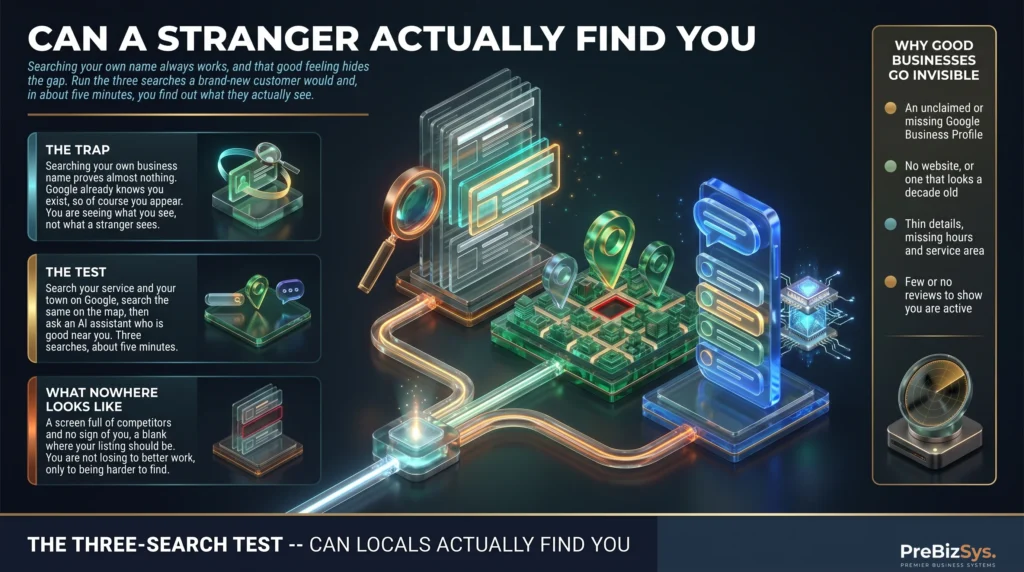
Searching your own business name proves almost nothing. Of course you show up: Google knows you typed it, and it already knows your business exists. You’re not testing what a stranger sees. You’re testing what you see, and you were never the customer you’re worried about.
The customer who matters doesn’t know your name yet. They don’t type “Dockside Ready Mix.” They type “ready-mix concrete near me” or “dumpster rental [their town].” That’s the search that brings a new job, and it’s the one most owners never check. The name search always works. The search that actually feeds your business is the one you have to look at honestly.
Here’s the uncomfortable part: the longer you’ve been in business, the more reassuring that name search feels, and the easier it is to assume the online side is handled. Meanwhile the customer who’s ready to buy today is a few towns over, typing your service into their phone, and quietly hiring whoever shows up first. You never see that lost job, because it was never a call that came in. It’s the work that went somewhere else before you knew it existed.
The 5-minute test: what should you actually type?
Don’t search your name. Search the way a customer who’s never heard of you would. Run these three, in order:
- Google Search. Type “[your service] + [your town]”: for example, “concrete supplier [your town]” or “dumpster rental [your town].” Look at who comes up before you do.
- Google Maps. Open Maps and search the same phrase. See whether your business appears in the little group of pinned results near the top, and whether your competitors are there instead.
- An AI assistant. Open ChatGPT (or Google’s AI answer) and ask, “Who’s a good [your service] near [your town]?” See whether your business gets named at all.
That’s it. Three searches, about five minutes. Write down what you find for each one, because the gaps between them tell you almost everything.
What does a good result look like, and what does “nowhere” look like?
A good result means you show up where customers are actually looking. On Google, your business appears on the first page for your service and town. On Maps, you’re in the map pack: the small group of three businesses Google pins at the top of the map, where most of the clicks and calls land. You have a real listing with hours, a phone number, and reviews. You have a website a customer can open. And when someone asks an AI for a recommendation, your name comes up. When all three line up, a stranger can find you, trust you, and call you without ever knowing your name in advance. That’s exactly the customer you’re trying to win.
Map pack: the group of three local businesses Google shows pinned to the top of the map for a local search. Being in it is where most local clicks and calls come from.
“Nowhere” looks like a screen full of your competitors and no sign of you: a blank where your listing should be, no website, or an AI answer that names three other businesses and skips yours entirely. If that’s what you see, you’re not losing to better work. You’re losing to being easier to find.
Why are there three places to check, not one?
Because Google Search, Google Maps, and AI answers each work differently, and you can win one while you’re invisible in the others. Search is about your website and listing showing up for the words people type. Maps runs on your Google Business Profile, the free listing that powers the map pack. AI answers are built from the trustworthy, consistent information already out there about you. Being strong in one and absent in the others is the silent killer, because the customer only needs to miss you in the place they happened to look. And different customers look in different places: one still starts on Google, the next opens Maps right on the job site, and a growing number simply ask an AI and trust the short list it reads back.
We’ve watched this exact gap open up firsthand. We’ve built the front door for a concrete yard, a dumpster company, a storage developer, a yacht charter, and a recycling firm that needed a permit portal: one owner, five industries. On the concrete build (Dockside Ready Mix) and the dumpster build (1-888-Dumpster), the owners showed up perfectly for their own business name and were nearly invisible for the search that actually brings new jobs. When we started those builds, this was exactly the gap we found. That’s not a ranking promise; it’s the diagnosis, and it’s the same one we run on day one of every project.
Why is a real, good business invisible?
Usually for one of a few plain reasons, and none of them are about the quality of your work:
- No Google Business Profile, or one that was never claimed. If you haven’t claimed it, you can’t control it, and you may not appear on Maps at all.
- No website, or one that looks a decade old. A stranger reads that as “less legitimate than the competitor.”
- Thin information. Missing hours, no service area, no list of what you actually do, so Google isn’t sure when to show you.
- Few or no reviews. Less proof for both customers and Google that you’re active and trusted.
None of these are about whether you’re good at the job. They’re about whether Google and a first-time customer can tell: quickly, on a phone, without calling around to find out. The good news is that every one of them is fixable, and most of them are free.
What should you fix first?
Claim and complete your Google Business Profile. Everything else builds on it. It’s free, it’s the listing that feeds the Maps map pack, and it’s the single highest-impact thing a local business can do to start showing up for the searches that bring new work. Once it’s claimed and filled out properly (the right category, your real services, your service area, your hours), you’ve fixed the foundation the other two places lean on. (We walk through exactly how in our guide to setting up your Google Business Profile.)
If your AI result came back blank, don’t panic about it: that usually fixes itself once the fundamentals are consistent. (Here’s what “showing up in ChatGPT” actually means for a local business.)
Run the three searches today. Five minutes will tell you more about where you’re losing customers than a month of guessing. And if you’d rather not read the results alone: want us to run the full version of this check for you? Book a visibility audit. We’ll show you exactly where you stand in all three places, and what to fix first. It’s a diagnosis, not a sales pitch: you’ll know where you actually stand when we’re done.