The honest answer: a Google Business Profile can get a local business found and even get the phone ringing. But for most businesses it isn’t enough on its own, and you want both. Your Profile is space you rent from Google: it gets you discovered, but Google controls what it shows and can change the rules anytime. A website is the part you own: it earns trust, answers the questions a listing can’t, and lets customers book or buy. The bigger or more trust-dependent your service, the more the website matters. Here’s how to tell what your business actually needs.
Most agencies won’t give you that answer straight, because “yes, you need a website” is what sells the website. We’ll tell you the real version: for a few businesses, a well-run Profile alone can keep the phone ringing for a while. For most, it’s the front step, not the whole house. The useful question isn’t “Profile or website.” It’s “how much does trust and control matter for my kind of customer?”
What does a Google Business Profile do well?
A Google Business Profile does the getting-found job, and it does it well. It puts you on Google Search and Google Maps, shows your hours and photos and reviews, and gives someone a “Call” and “Directions” button right there in the results.
Google Business Profile: the free Google listing that shows your business on Google Search and Google Maps: name, hours, phone, photos, reviews, and a “Call”/”Directions” button. Google hosts it; you claim and control the fields.
For a fast, simple decision, that can be almost the whole transaction. Someone needs a service today, searches on their phone, sees your listing and your reviews, and taps “Call.” No website required for that moment. If your business lives on quick, urgent, low-research jobs, the Profile is carrying a lot of the weight, and getting it complete and well-reviewed is the highest-value free thing you can do. (If you haven’t set yours up properly yet, here’s how to do it right.)
But notice what the Profile is doing in that story: it’s getting you found and getting you a call. It isn’t building trust over time, it isn’t answering the harder questions, and it isn’t a place that’s truly yours. That’s where the limits start.
Where does a Profile fall short?
A Profile falls short in three places: control, trust, and depth. And underneath all three is one idea worth sitting with.
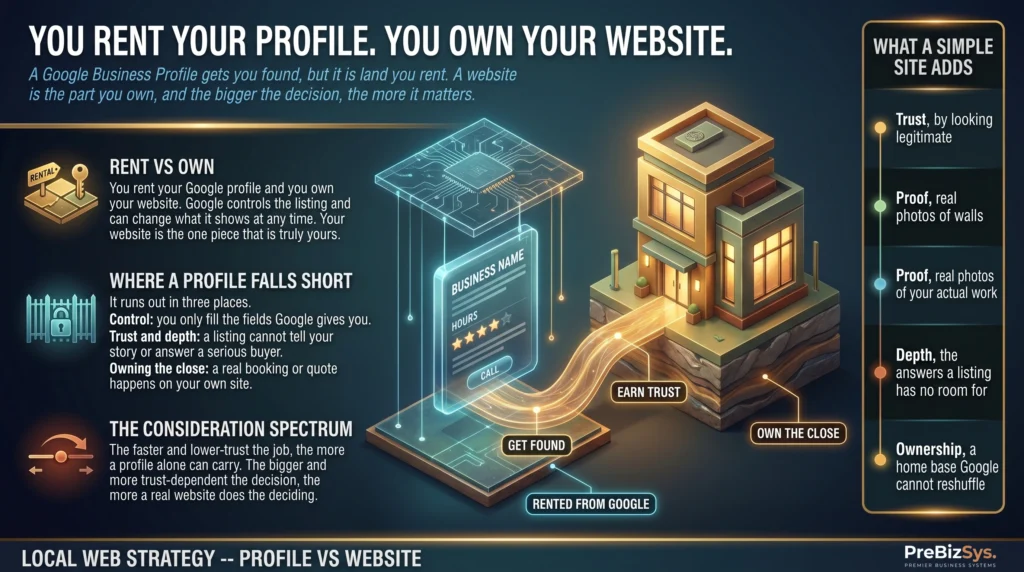
You’re renting on Google; the website is the land you own. Your Profile is borrowed space. Google decides the layout, the rules, and what shows; it can change any of that tomorrow without asking you. A competitor’s ad can sit on top of your listing. A policy change can reshuffle what customers see. You’re a tenant on land you don’t control.
That borrowed-space problem shows up as real limits:
- Control: you fill in fields Google gives you; you can’t design the experience or decide what comes first.
- Trust and depth: a listing can’t tell your story, show your process, walk through a big or unfamiliar purchase, or answer the ten questions a serious buyer has before they commit.
- Owning the close: a Profile points people at you; a website is where a real booking, quote request, or purchase can actually happen on your terms.
For a quick job, none of that may matter much. For a bigger one, all of it does.
Does it depend on what you sell? (Yes.)
Yes, and this is the part that actually decides it. The more a purchase depends on trust, the more a website matters. We think of it as a spectrum, and we’ve built across the whole thing.
On one end: fast, low-trust decisions. A same-day dumpster rental is a “I need it now, are you available, can I call you” decision. The customer isn’t researching your company history; they need a problem solved today. That’s the kind of business we built 1-888-Dumpster for: a dumpster-rental site designed for urgent need and click-to-call, a simple site whose whole job is to convert a ready buyer fast. A strong Profile plus a lean site can carry most of that.
On the other end: high-trust, high-consideration decisions. Self-storage means handing over your belongings; a real-estate development decision is a serious commitment. People look harder, longer, before they say yes, and a free listing simply can’t carry that weight. That’s why we built D-Best Development, a self-storage and property-development site, to present a serious operation seriously, with the credibility a higher-consideration buyer needs to see. The same is true at the premium end: a yacht charter is a “do I trust these people with a special occasion” decision, so we built Borough Yachts, a premium yacht-charter site, to deliver a polished, high-end feel a listing could never convey.
The consideration spectrum: the faster and lower-trust the purchase, the more a Profile alone can handle. The bigger and more trust-dependent it is, the more a real website does the deciding.
Here’s the honest line we can give you because we’ve actually built both ends: we’ve built sites for a same-day dumpster company and for a storage developer and a premium charter. One owner, very different bars. That range is how we know where the line falls for your kind of business, instead of selling everyone the same answer.
What does even a simple website add?
Even a simple website adds the four things a Profile can’t: trust, proof, depth, and ownership. It’s a place that’s yours, where the impression isn’t dictated by Google’s layout, and where a serious buyer can get the fuller picture before they commit.
It earns trust by existing and looking legitimate. It offers proof: real photos of your work, the range of what you do, who you are. It answers depth: the questions a listing has no room for. And it gives you ownership: a home base that doesn’t disappear or reshuffle when Google changes the rules. None of that has to be elaborate. A clean, fast, honest site does the job; you don’t need a sprawling production.
It also strengthens the Profile itself: a real, consistent website is one of the signals that helps Google and customers treat your listing as the genuine article rather than a thin, half-claimed one.
What does a good small-business site actually need (and not need)?
A good small-business site needs to be clear, fast, mobile-friendly, and built around the few pages that actually matter. It does not need to be big, fancy, or stuffed with everything.
The short list most local businesses actually need:
- A clear home page: who you are, what you do, where you work, and an obvious way to contact you.
- What you offer: your services in plain language, the way customers describe them.
- Proof: real photos, and the honest story of your work.
- An easy way to act: call, request a quote, or book, visible on every screen without hunting.
- Fast and mobile-first: most local searches happen on a phone; a slow or clunky site loses the customer before the content ever loads.
What you can skip: bloat. You don’t need a dozen pages, stock photos that look like everyone else’s, animations, or a blog you’ll never update. For a local business, a tight site that loads fast and makes the next step obvious beats a big one that impresses nobody and loads slowly.
How do a Profile and a site work together?
They work together as a two-part system: the Profile gets you found, and the site closes the deal. The Profile is discovery: it puts you in front of someone searching nearby. The website is conviction: it’s where that person confirms you’re legitimate, gets their questions answered, and takes the next step.
Each one makes the other stronger. The Profile sends people to a site that earns their trust; the site backs up the Profile with the consistency and legitimacy that helps you show up in the first place. Lean on only one and you’ve got half the system: a great Profile with no site can get the call but not always close the bigger job; a great site nobody can find on Maps never gets the chance. The businesses that do best locally run both, sized to what their customers actually need to say yes.
And that sizing is the whole question, which is exactly the thing worth getting right before you spend a dollar. Not sure whether your business needs a full site or a simple one? Start with an audit: we’ll tell you honestly what your kind of customer needs to say yes, and build exactly that. It’s a diagnosis, not a sales pitch: you’ll find out where you actually stand and what’s worth doing, before anyone builds anything. (Worried your current setup is quietly turning customers away? Here are the five signs you look outdated online.)