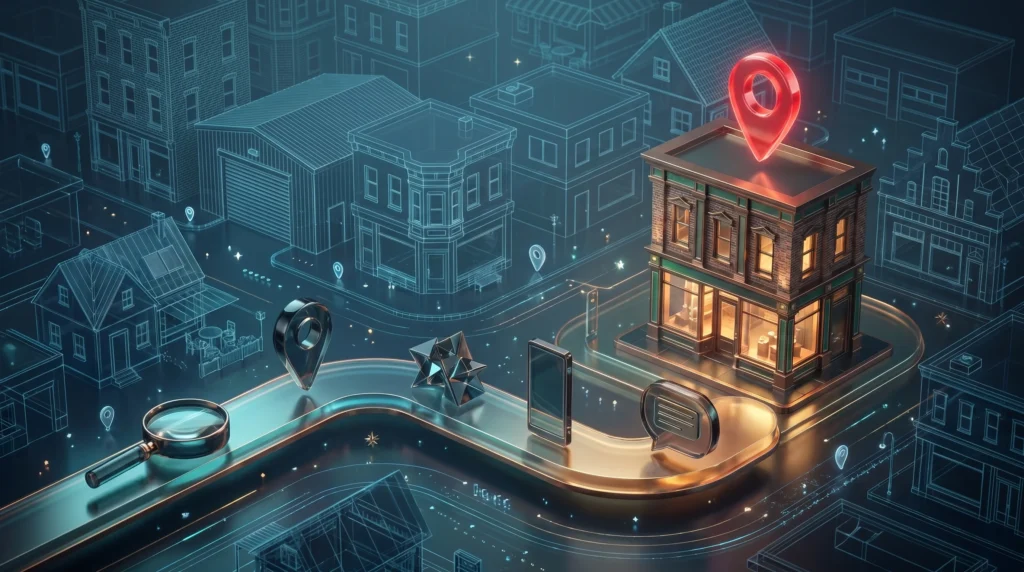
Customers pick a local business in 2026 through a quick chain of steps: they search on Google, check Google Maps, read recent reviews, glance at the website, and (more and more) ask an AI assistant like ChatGPT for a recommendation. Even word-of-mouth referrals now run through this chain: the person who was recommended to you still looks you up before they call. Word-of-mouth didn’t disappear; it moved online and added a verification step. If a business can’t be found or doesn’t look trustworthy at any link in that chain, it quietly loses customers it never knew it had.
If you’ve been in business a while, none of this is meant to alarm you; it’s meant to make something visible. The way customers decide has shifted under everyone’s feet, quietly, and the businesses that adjust to it are the ones that keep getting picked. Here’s the honest picture of how that decision works now.
How did people used to choose, and what changed?
People used to choose a local business through people and the phone book. A neighbor gave you a name, or you flipped to the listing, and you called. The decision happened almost entirely offline, and the business had very little to do but answer the phone.
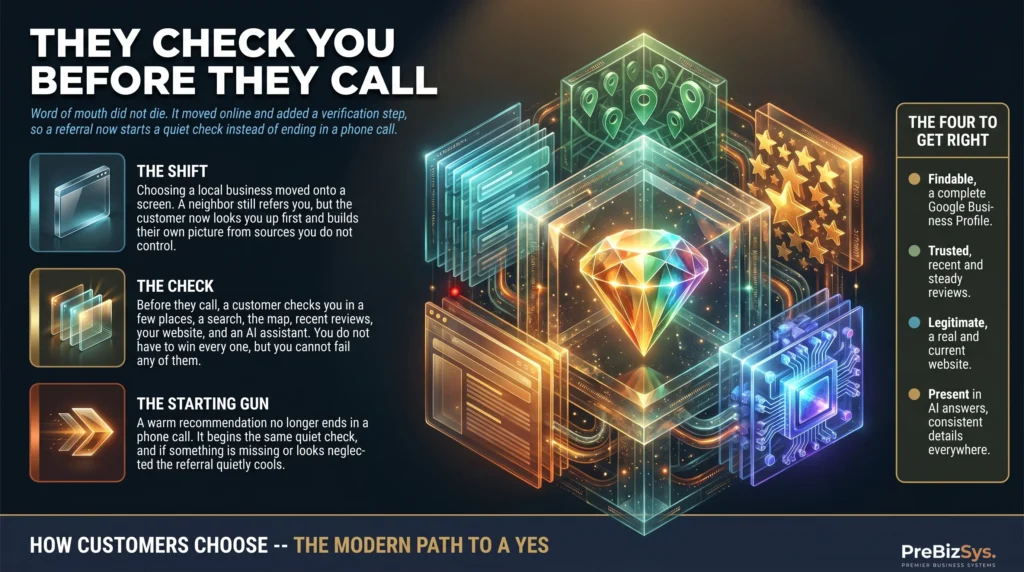
What changed is that the whole decision moved onto a screen. The phone book became Google. The neighbor’s recommendation still happens, but now it’s followed by a look-up. The customer has tools the old buyer never had: they can see your reviews, your photos, your map pin, your website, and ask an AI for a shortlist, all in about ninety seconds before they ever dial. The decision used to start and end with a name. Now the name is just the start.
The deeper shift is who holds the information. It used to be you: the customer learned about your business mostly from you and from the person who referred them. Now the customer gathers their own picture from a dozen sources you don’t control: your listing, strangers’ reviews, an AI’s summary. You don’t get to make your case first anymore; you get checked first, and the business that holds up under the check is the one that gets the call. That’s not worse, just different, and it rewards the owners who make sure the picture out there is accurate and current.
What’s the modern path to a “yes”?
The modern path to a “yes” is a short chain a customer runs, often in a minute or two, before they contact you:
- Search Google for the service: “[your service] near me” or “[your service] + [your town].”
- Check Google Maps: the map pack, your pin, your star rating.
- Read recent reviews: what other people say, and how recent it is.
- Glance at the website: is it real, current, and does it answer their question?
- Ask an AI assistant: increasingly, “who’s a good [service] near [town]?” to get a shortlist.
The modern path consists of five steps: “search → Maps → reviews → website → an AI question.” A business must succeed at each stage; a weakness anywhere silently removes it from consideration.
You don’t have to “win” every step dramatically; you have to not fail any of them. A strong Google listing with no website, or great reviews that stopped two years ago, is a chain with a weak link. The customer rarely tells you where you lost them; they just call someone else.
Most of this happens before you ever know the customer exists. They’re on a phone, they’re quick, and they’re comparing you to two or three others at the same time. Each step is a small yes-or-no: found them, looks active, real reviews, decent site, an AI named them. A “no” anywhere (a missing listing, a dead-looking profile, no site to confirm you’re real) and they move on without a second thought. The good news in that is the flip side: every link you shore up is one more place a wavering customer decides to stay with you instead of clicking away.
What’s the new step most owners miss?
The new step most owners miss is the last one: people now ask AI assistants for a recommendation. Someone types “who’s the best [your service] near [your town]?” into ChatGPT or Google’s AI and gets a short list of named businesses. If you’re not in it, you were never in the running for that customer.
Most owners haven’t checked whether they show up there because it’s new and it feels technical. It isn’t, really: it runs on the same fundamentals as the rest of the chain (a complete profile, real reviews, a legitimate site, consistent information). But it’s the step almost nobody has looked at, which makes it both the easiest to miss and, right now, the easiest place to get ahead.
But what if you live on word-of-mouth?
If you live on word-of-mouth, here’s the part worth sitting up for: the referral isn’t the finish line anymore; it’s the starting gun. A warm recommendation used to end in a phone call. Now it kicks off the same quiet background check as everything else. Your neighbor says “call these folks,” and before they call, the customer Googles you, glances at your reviews, looks for a website. If something’s missing or looks neglected, the referral quietly cools.
This is the trap hiding inside “I don’t need online stuff, I get all my work from referrals.” You might be losing referred customers you never even knew were sent your way: they looked, didn’t find enough to feel sure, and went with someone who looked the part.
It helps to picture what the referred customer is actually doing. They’re not trying to catch you out; they’re trying to feel safe spending money. So they look for small signals of reassurance: a profile that’s clearly yours, reviews that sound like real people, a website that confirms you do the work and you’re still around. When those line up, the referral hardens into a call. When they’re missing, the customer feels a flicker of doubt they can’t quite name, and doubt at the moment of choosing almost always loses. The recommendation got you onto the field; the online picture decides whether you stay on it.
These are exactly the kinds of businesses we build for. Our ready-mix concrete supplier (Dockside Ready Mix) and our dumpster-rental company (1-888-Dumpster) are classic word-of-mouth, phone-first trades, the kind that have always run on referrals and reputation. That’s why getting the online picture right matters more for them, not less: when a referred customer looks them up, what they find has to confirm the recommendation, not undercut it. We’re not claiming a number of recovered referrals; we’re pointing at the pattern, because the pattern is real and it’s quiet.
What are the four things to get right to be the one they pick?
To be the business that gets picked at the end of that chain, get four things right:
- Findable: a complete, accurate Google Business Profile so you show up in search and on Maps.
- Trusted: recent, steady reviews that a customer reads as proof you’re active and reliable.
- Legitimate: a real website that confirms you exist, answers the obvious questions, and looks current.
- Present in AI answers: consistent information across the web so AI assistants can confidently name you.
The four essentials are: “findable (Google Business Profile), trusted (reviews), legitimate (a real website), and present in AI answers.” Each represents one link in the customer’s decision chain; together they determine whether you’re the one selected.
None of these is exotic, and none of them is a trick. They’re the modern version of “be easy to find and easy to trust”: the same job a good reputation always did, now done in the places customers actually look.
The hard part isn’t fixing any one of these; it’s seeing the whole chain the way a customer does, and spotting which link is leaking. That’s exactly what we do. Want to see how your business looks at each step a customer takes? Our audit walks the whole path (search, Maps, reviews, site, and AI) and shows you where you’re leaking. It’s a diagnosis, not a promise: you’ll see what a customer sees at every step, and what to shore up first to give yourself the best shot at being the one they pick.