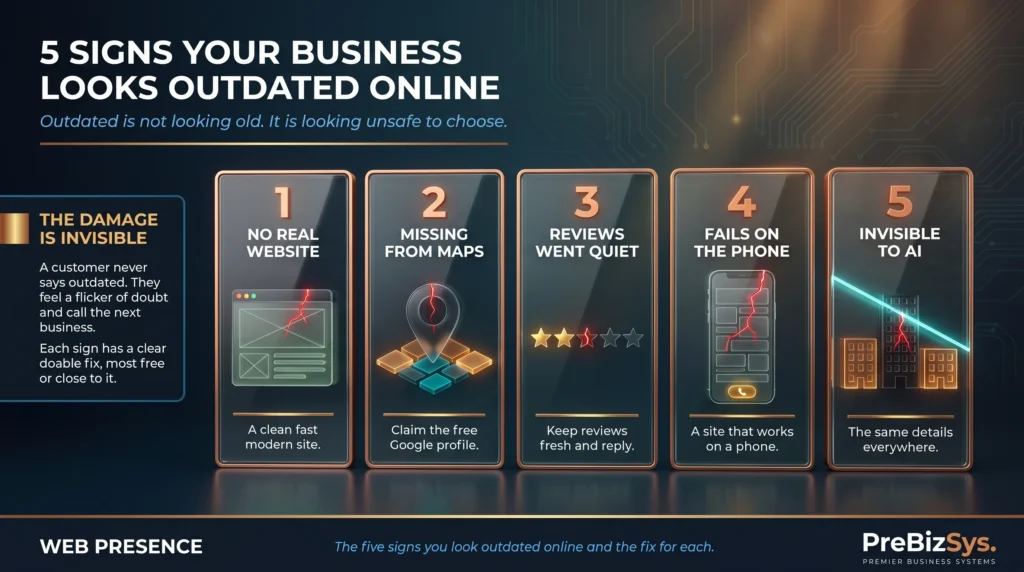
The five most common signs a business looks outdated online are: (1) no website, or one that looks like it’s from a decade ago; (2) not showing on Google Maps, or a profile that’s never been claimed; (3) few reviews, or reviews that stopped years ago; (4) a site that doesn’t work right on a phone; and (5) being invisible when customers ask an AI assistant for a recommendation. “Outdated” here isn’t really about looking old. It’s about every spot where a stranger sizes you up and quietly decides you’re not the safe choice. The good news: each sign has a clear, doable fix. Here’s how to spot each one and what to do about it.
One thing worth saying up front: “modern” doesn’t mean the same thing for every business. We’ve built sites where the bar is flawless and premium, and sites where the bar is “just let me call you fast.” So as you read each sign, measure it against your customer, not against some generic idea of a fancy website.
And here’s the part most owners miss: a customer almost never thinks the words “this looks dated.” They just feel a small flicker of doubt and move on to the next result, so the damage is invisible to you. You don’t see the lost job; you simply never get the call. That’s why it’s worth checking deliberately, sign by sign: the problems that cost you the most are usually the ones you’ve stopped noticing.
Sign 1: No website, or one stuck a decade in the past?
If you have no website, or one that clearly hasn’t been touched in years, you look less legitimate than the competitor who does, even if your work is better. The cost: a stranger comparing two businesses quietly picks the one that looks current, because “current” reads as “still in business and still cares.” The fix: a clean, fast, modern site. It does not need to be big; it needs to look like you’re a real, present, professional operation.
The tells are easy to spot once you look: text you have to pinch to read, a layout that breaks on a phone, no little padlock in the address bar, a copyright year stuck several years back, or a design that simply feels like a different era. Any one of them is enough to plant the doubt.
What “modern” means here depends entirely on who you serve. For a premium service, the bar is high: we built Borough Yachts, a polished yacht-charter site, because for that buyer a first impression that feels anything less than flawless is disqualifying. For a serious, higher-trust operation, the bar is “present this professionally”: we built D-Best Development, a self-storage and property-development site, so a serious business reads as serious. Same principle, two very different bars. And that’s the point. The fix is calibrated to your customer, not copied from someone else’s industry.
Sign 2: Not on Google Maps, or a profile you never claimed?
If you don’t appear on Google Maps, or your Google Business Profile was never claimed, you’re invisible to the people searching for your service nearby. The cost: every “near me” search hands those customers to whoever did claim and complete their profile. The fix: claim and complete your Google Business Profile. It’s free, and it’s the listing that puts you on the map.
This is the most common and most fixable sign on the list. A lot of businesses are “outdated online” purely because a free listing is sitting unclaimed.
And here’s the quiet part: while your listing sits unclaimed, a competitor’s complete one is the only thing the searcher sees. They aren’t choosing them over you. They never saw you at all.
Sign 3: A handful of reviews, or reviews that stopped years ago?
If you have very few reviews, or a cluster of reviews that all stopped two or three years ago, customers feel it at the exact moment they’re deciding. The cost: doubt right at the point of choosing. A profile that looks frozen makes a stranger wonder if you’re still active or still good. The fix: a simple, repeatable way to ask every happy customer for a review, so fresh ones keep arriving.
Recent and steady beats a big pile that went quiet. A business with a handful of fresh, answered reviews often reassures a customer more than one with a hundred that ended years ago.
Replying matters as much as collecting. A few thoughtful responses, even to a lukewarm review, tell the next reader that a real person is paying attention. A wall of reviews with no replies reads as a business running on autopilot.
Sign 4: A site that fights people on a phone?
If your website is hard to use on a phone (tiny text, broken layout, a phone number you can’t tap), you’re losing customers who are standing there ready to call. The cost: most people look you up on their phone now, and a clunky mobile experience loses them in seconds; they bounce back and call the next business. The fix: a mobile-first site where the most important action is dead simple. For many local businesses, that’s calling you in two taps.
This is exactly what some businesses need most. We built 1-888-Dumpster as a phone-first, click-to-call site, because that customer has decided they need a dumpster today. The whole job of the site is to let them call you in two taps without fighting the screen. For a fast, urgent-need service, “modern” mostly means “don’t get in the way of the call.”
The failures are specific and common: a number you can’t tap to dial, buttons too small for a thumb, text you have to zoom in to read, a page that crawls on mobile data. Each one is a small reason to give up, and on a phone, giving up takes a single tap.
Sign 5: Invisible when customers ask an AI?
If your business doesn’t come up when someone asks an AI assistant like ChatGPT “who’s a good [your service] near [your town]?”, you’re missing from a fast-growing way people now choose. The cost: you’re absent from the new “who’s best near me” answers, and you never even know it happened. The fix: the same fundamentals that get you found everywhere else (a complete profile, real reviews, a legitimate site), plus keeping your details consistent everywhere they appear.
There’s no AI ad to buy and nothing to submit. AI assistants build their answers from trustworthy, consistent public information, so the path into them runs straight through the fundamentals, not around them.
The thing that quietly disqualifies you here is inconsistency: if your name, phone, or address say different things in different places, an AI can’t tell which is right, so it leaves you out rather than risk a wrong answer. Getting your details to match everywhere is unglamorous, and it’s exactly what helps.
How do you get all five checked at once?
The honest answer is you can check all five yourself with the steps above, and you should. But if you’d rather not guess, that’s exactly what we do. Not sure how many of these five apply to you? Our audit checks all five at once and gives you a clear, prioritized fix list: no jargon, no pressure. It’s a diagnosis: you’ll walk away knowing exactly where you stand and what to fix first. Most businesses don’t have all five problems; they have one or two that matter and three that are fine. The value isn’t a long, scary list; it’s knowing which one or two are actually costing you customers, so you fix those first and leave the rest alone.
Whichever way you do it, the takeaway is the same: “outdated online” isn’t a vanity problem. It’s the quiet flicker of doubt that sends a customer to someone else before you ever hear the phone ring. Every one of these five has a fix, and most of them are free or close to it.